

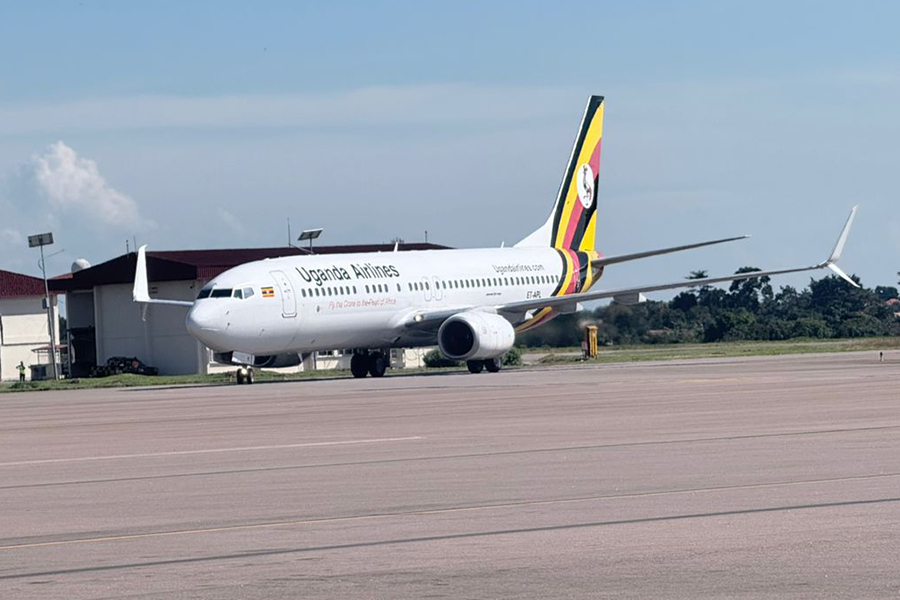
Uganda Airlines has received a wet-leased Boeing 737-800 aircraft from Ethiopian Airlines, registered ET-APL, in a strategic move aimed at easing operational pressure on its expanding regional and international network.
The aircraft arrived on Tuesday as the first of two wet-leased jets expected under a partnership arrangement with Ethiopian Airlines.
The deal is intended to improve schedule reliability, enhance operational flexibility, and stabilise services that have recently experienced disruptions due to fleet limitations.
The national carrier confirmed the development through its official communication channels, describing the addition as part of ongoing efforts to strengthen capacity and improve service delivery across its network.
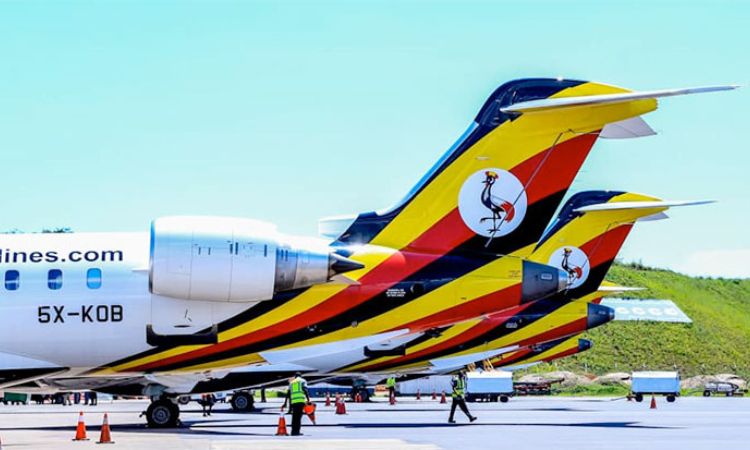
Uganda Airlines currently operates a fleet consisting of two Airbus A330-800neo aircraft dedicated to long-haul operations, one Airbus A320-200, and four Bombardier CRJ900 regional jets.
While this fleet has enabled the airline to rapidly expand since its revival in 2019, it has also exposed operational strain as the carrier continues to add new routes.
Industry observers have repeatedly warned that the airline’s aggressive expansion strategy has stretched its limited fleet, leaving little margin for disruption or maintenance downtime.
This vulnerability became more evident following the launch of several long-haul and regional routes over the past two years.
One of the most significant milestones in the airline’s recent history was the launch of the direct Entebbe–London Gatwick route in May 2025.
The service marked Uganda’s return to direct connectivity with the United Kingdom after nearly a decade and was widely celebrated as a breakthrough for tourism, exports, and diaspora travel.
However, the route also intensified pressure on the airline’s long-haul fleet. With only two Airbus A330-800neo aircraft available, any technical issue or scheduled maintenance immediately affects operations across multiple destinations, including Dubai and Mumbai, in addition to London.
This lack of redundancy has made operational continuity increasingly difficult. In September 2025, Uganda Airlines experienced widespread delays and cancellations across several international routes after technical issues affected parts of its long-haul operations.
The disruptions impacted flights to London, Dubai, and Mumbai, drawing criticism from passengers and raising concerns about the sustainability of its network.
Passengers reported last-minute schedule changes, extended delays, and communication gaps during the disruption period, highlighting the operational risks of running an expanding international network with a limited number of aircraft.
Aviation analysts noted that while Uganda Airlines has made significant progress in establishing new routes and increasing passenger traffic, its fleet size remains insufficient to fully support its ambitions.
The absence of standby aircraft means that even minor disruptions can cascade across multiple routes.
At the same time, the airline continues to maintain a growing regional network covering key African cities including Nairobi, Johannesburg, Kinshasa, Lagos, Juba, Bujumbura, Dar es Salaam, Mombasa, and Mogadishu.
Balancing these regional operations alongside long-haul flights has placed additional strain on available aircraft.
The arrival of the Boeing 737-800 wet lease is therefore expected to provide immediate operational relief. The aircraft will increase fleet availability and allow Uganda Airlines greater flexibility in managing aircraft rotations, maintenance schedules, and route assignments.
Under a wet-lease arrangement, Ethiopian Airlines provides the aircraft together with crew, maintenance, and insurance.
This model allows Uganda Airlines to quickly scale capacity without the lengthy procurement and certification process required for permanent aircraft acquisition.
Aviation experts say wet leasing has become increasingly common among African airlines facing similar fleet constraints. The arrangement offers a short-term solution to operational gaps while longer-term fleet expansion plans are developed.
Ethiopian Airlines, widely regarded as Africa’s largest and most successful carrier, has increasingly positioned itself as a strategic partner for other airlines across the continent. Its technical expertise and operational scale have made it a preferred partner in wet-lease and capacity-sharing agreements.
The partnership between Uganda Airlines and Ethiopian Airlines also reflects a broader trend of cooperation among African carriers, as airlines seek ways to manage rising costs, aircraft shortages, and global supply chain disruptions affecting aircraft availability and maintenance cycles.
The Boeing 737-800 is expected to be deployed primarily on high-demand regional routes where passenger traffic has steadily increased. Routes such as Nairobi, Johannesburg, Kinshasa, and Lagos are among those likely to benefit most from the additional capacity.
These destinations are central to Uganda Airlines’ regional strategy, connecting major commercial hubs and supporting trade, business travel, and regional integration under frameworks such as the African Continental Free Trade Area (AfCFTA).
Despite its growth, Uganda Airlines faces intense competition across its network. It competes directly with established regional carriers including Ethiopian Airlines, Kenya Airways, RwandAir, and Air Tanzania, all of which operate larger fleets and more extensive route networks.
This competitive environment has placed pressure on Uganda Airlines to maintain reliability, punctuality, and consistency in service delivery, even as it continues to expand.
The airline’s management has acknowledged that fleet expansion remains a critical priority for long-term sustainability. Government has already approved plans for additional aircraft acquisitions, particularly narrow-body jets that will support medium-haul and regional operations.
These future additions are expected to reduce reliance on short-term wet leases while improving operational resilience and network stability.
The arrival of the Ethiopian Airlines-operated Boeing 737-800 comes at a time when Uganda Airlines is also undergoing internal restructuring and leadership changes. The airline has faced governance scrutiny, financial pressure, and operational challenges in recent years.
In February 2026, government directed leadership changes at the airline, appointing veteran aviation executive Girma Wake as Acting Chief Executive Officer and consultant to oversee reforms.
The move followed concerns over financial performance and operational efficiency.
Wake, a former Ethiopian Airlines CEO credited with transforming the carrier into Africa’s leading airline, was tasked with stabilising Uganda Airlines and guiding its restructuring process while a search for a substantive CEO continues.
Parliamentary reports have indicated that Uganda Airlines has recorded significant financial losses since its revival, including a net loss of Shs 237.9 billion in the 2023/2024 financial year, despite strong growth in passenger revenues.
Supporters of the airline argue that such losses are typical in the early stages of national carrier development, particularly when airlines are investing heavily in new routes, infrastructure, and international market entry.
They point to the strategic importance of direct international connectivity, noting that Uganda Airlines’ routes to London, Dubai, and other major cities have strengthened trade links, reduced travel times, and improved Uganda’s visibility in global aviation markets.
However, sustaining these routes has proven operationally demanding given the airline’s limited fleet size. Reports of aircraft unavailability due to maintenance have at times forced schedule adjustments and cancellations, reinforcing concerns about fleet resilience.
In this context, the wet-leased Boeing 737-800 provides a crucial operational buffer. It is expected to improve reliability in the short term while the airline continues working toward long-term fleet expansion and restructuring goals.
Officials at Uganda Airlines described the aircraft’s arrival as a positive step toward strengthening connectivity and enhancing service delivery across its network.
For many observers, the development reflects both the opportunities and challenges facing Uganda Airlines as it seeks to position itself as a competitive regional carrier. While demand for its services continues to grow, its ability to sustainably meet that demand will depend heavily on fleet expansion, operational discipline, and financial stability.
In the short term, however, the addition of the Ethiopian Airlines wet-leased Boeing 737-800 offers Uganda Airlines much-needed breathing space as it navigates one of the most demanding phases since its revival.
